A finished order inspection checklist should connect the purchase order to a clear decision about the goods and shipment. Identify the lot, product requirements, sampling method, critical checks, packaging expectations, documents, and the person authorized to accept or reject a result. A checklist records observations against agreed criteria; it does not create technical or legal requirements after production is complete. Set its scope with the buyer, supplier, and relevant technical owner before inspection.
Key takeaways
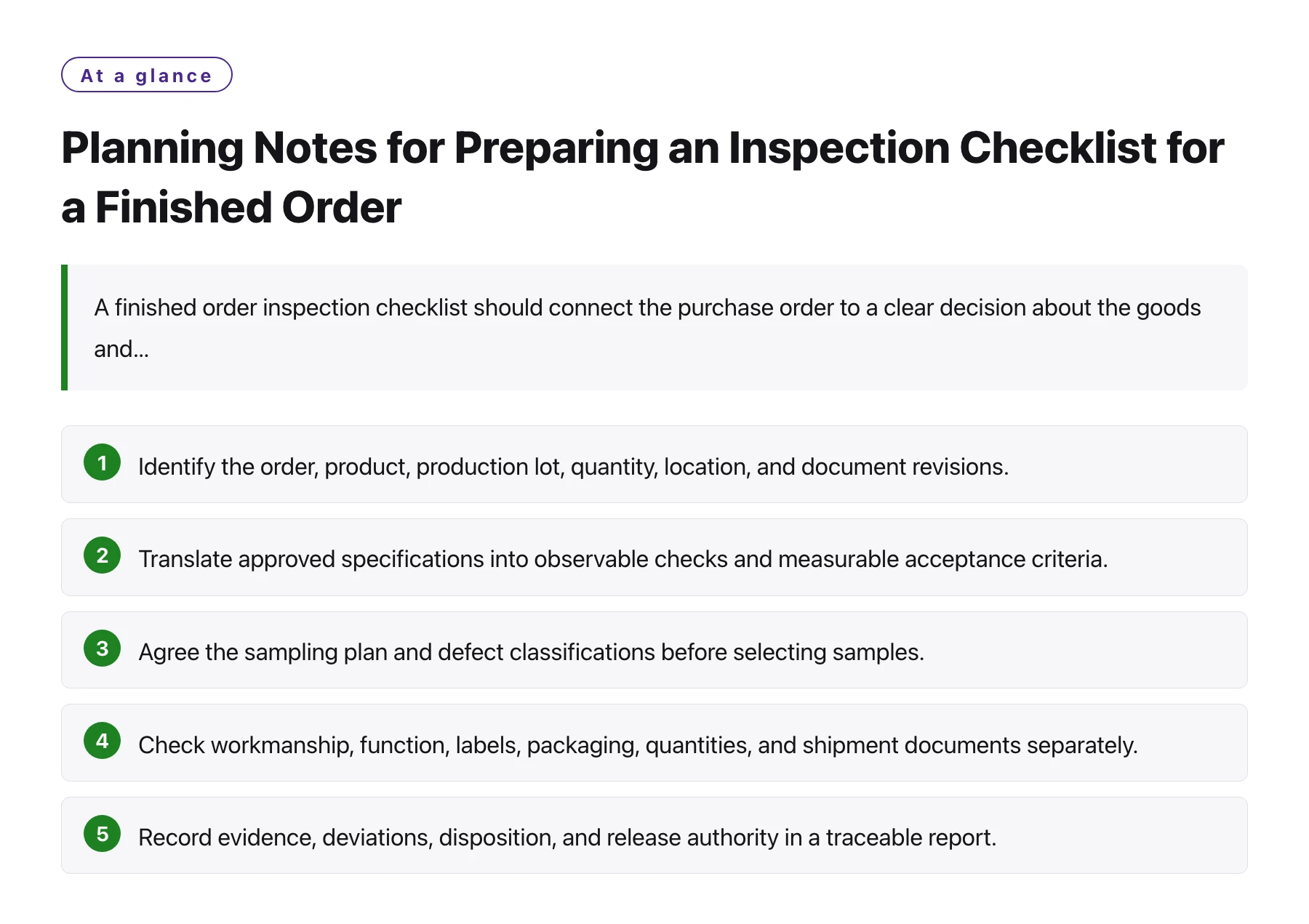
- Identify the order, product, production lot, quantity, location, and document revisions.
- Translate approved specifications into observable checks and measurable acceptance criteria.
- Agree the sampling plan and defect classifications before selecting samples.
- Check workmanship, function, labels, packaging, quantities, and shipment documents separately.
- Record evidence, deviations, disposition, and release authority in a traceable report.
A useful checklist is short enough to execute consistently and specific enough to support a decision.
1. Define inspection scope and readiness
Record buyer, supplier, purchase order, inspection address, planned date, product family, models, production lots, and total quantity. State whether the visit covers one order, a defined lot, or selected cartons from a larger run. Confirm production completion, packing status, access to samples, and the supplier contact who can answer technical questions. If goods are not ready, document the gap and agree a new milestone rather than reporting an incomplete inspection as a full pass.
List the documents that establish the approved baseline: specification, drawings, bill of materials, artwork, sample approvals, purchase order, change notices, and market-specific requirements. Add revision and approval dates. A checklist should point to those controlled records instead of copying long requirements into a field form where they can become inconsistent.
2. Convert requirements into observable checks
For each requirement, write what is checked, how it is checked, what evidence is recorded, and the acceptance rule. Separate visual workmanship, dimensions, function, safety-related features, material identity, performance evidence, and document review. Identify test equipment or fixtures needed, measurement units, environmental conditions when relevant, and who is qualified to perform a specialized test. Avoid vague instructions such as “check quality” or “ensure good finish.”
Make every criterion traceable to the approved product and use. For example, a label check can name mandatory fields and artwork revision; a dimensional check can cite the drawing feature and tolerance; a function check can list the operating sequence. If the buyer has not defined a requirement or tolerance, mark it as an open decision before inspection rather than inventing a pass limit in the field.
3. Agree lot definition and sampling rules
Specify what constitutes the inspection lot, how the lot size is established, how samples are selected, and what acceptance or rejection rule applies. If the project uses an attribute sampling standard, identify the exact edition, inspection level, plan, and defect categories in the purchase or inspection agreement. ISO 2859-1:2026 describes AQL-indexed sampling schemes for lot-by-lot inspection by attributes; it does not replace the buyer’s responsibility to choose an appropriate plan and define product requirements. [1]
Do not use AQL as a promise that a particular percentage of defects is acceptable in every product or as proof that every uninspected unit conforms. Explain the selected plan to stakeholders before production is finished. For safety-critical, regulated, customized, or high-value features, the technical owner may require specific tests or controls beyond a sample-based visual inspection. Record any departure from the agreed method and the person who approved it.
4. Organize visual, functional, and measurement checks
Group checks so the inspector can complete them in a repeatable sequence. A visual review may cover appearance, workmanship, finish, color, completeness, and visible damage under stated lighting and viewing conditions. Functional checks should name the operation, load or setting, duration, expected response, and evidence. Measurements should identify the instrument, units, sample identity, result, and tolerance. Record failures against the exact product, sample, and requirement.
Select tests that are relevant to the item and buyer’s intended use. Do not claim that a brief inspection proves long-term durability, regulatory compliance, or every safety characteristic. If a specialist test, laboratory report, destructive test, or certification is required, put the method, sample handling, responsible party, and decision owner in the plan. Keep test results and visual findings as separate evidence categories.
5. Check quantity, identification, and packaging
Reconcile finished quantity, model mix, sizes, colors, accessories, spare parts, and package counts against the order and packing list. State whether counts are based on carton marks, opened samples, pallet tally, or another method. Inspect representative packaging for product protection, correct inserts, labels, barcodes, warnings, and destination information. Photograph carton marks and any mismatch, and note whether the affected goods were included in the shipment count.
Define packaging acceptance around the transport route and product fragility. Check carton condition, cushioning, moisture protection, pallet stability, stacking limits, and handling marks when these are part of the agreement. Verify that packaging revisions and labels match the approved artwork. If packing is incomplete or the shipment configuration has changed, state whether the inspection result applies only to unpacked product or also to final export packaging.
6. Review documents and traceability
List required documents by name, product, issuing party, revision, and status. Depending on the order, this may include test reports, material declarations, user instructions, certificates, warranty documents, inspection records, or shipping papers. Check that names, model codes, dates, factory details, and scope correspond to the goods. Note missing, expired, incomplete, or mismatched records without making unsupported conclusions about authenticity.
Where a document is essential to market access or a technical decision, assign review to the qualified compliance or engineering owner. A field inspector can record that a file was presented and flag a discrepancy; the checklist should not imply that a visual document check replaces issuer verification or formal regulatory review. Link the evidence file or report reference in the final record.
7. Capture findings and close the decision
For every failure or uncertainty, identify the requirement, item or lot, observed result, evidence, severity category, and proposed next step. Distinguish confirmed nonconformity from an unanswered question or an inaccessible check. Use numbered photos or attachments so reviewers can follow the finding without guessing which product is shown. Record whether the supplier corrected, sorted, reworked, replaced, or disputed the affected goods.
State the inspection outcome and its limits: accepted, rejected, conditional pending actions, or incomplete. Name the person authorized to decide shipment release and list the conditions that must be closed first. A report should not turn a conditional finding into approval because a truck or vessel is waiting. Buyers using Shanghai JS Sourcing can align checklist fields with their order and sampling plan before production completion.
Sources
Frequently asked questions
When should a finished-order inspection checklist be written?
Prepare it before the inspection date and preferably before production closes. That gives the buyer and supplier time to agree lot definition, criteria, sampling, access, and required evidence.
Does an AQL sampling plan guarantee that every unit is acceptable?
No. It is a lot sampling approach with defined selection and decision rules, not a guarantee about each uninspected item. Define critical requirements and additional controls separately.
What should be done when the product specification has no tolerance?
Record the missing criterion as an open decision and ask the responsible technical owner to define it. Do not invent a field acceptance limit after production has finished.
Can a pre-shipment inspection replace compliance review?
No. It can record product and document observations within its scope. Assign market obligations, specialized testing, and legal conformity decisions to qualified reviewers.