What Your Pool Hashrate Share Means for Your Payout Share
Hashrate share and payout share are the same number expressed in two units. A fleet of 1,000 TH/s inside a network running near 950.3 EH/s holds about 0.00010523% of Bitcoin's hashing power, which at difficulty 132.76 T multiplies out to 0.00047353 BTC a day — roughly $40.39 gross, or $38.77 after the listed 4% fee on the PPS-settled block reward.

Key takeaways
- Share is a proportion, not a quantity: 1,000 TH/s of 950.3 EH/s is 0.00010523% of network hashrate and returns 0.00047353 BTC a day.
- Money follows the share, not the hardware. Doubling hashrate doubles the share; letting the network grow 1.90% while standing still cuts per-terahash income by about 1.86%.
- PPS+ measures the share now and settles hourly at current difficulty; PPLNS measures it across the last 5 difficulty rounds and pays after 6 confirmations, roughly a 70-day window.
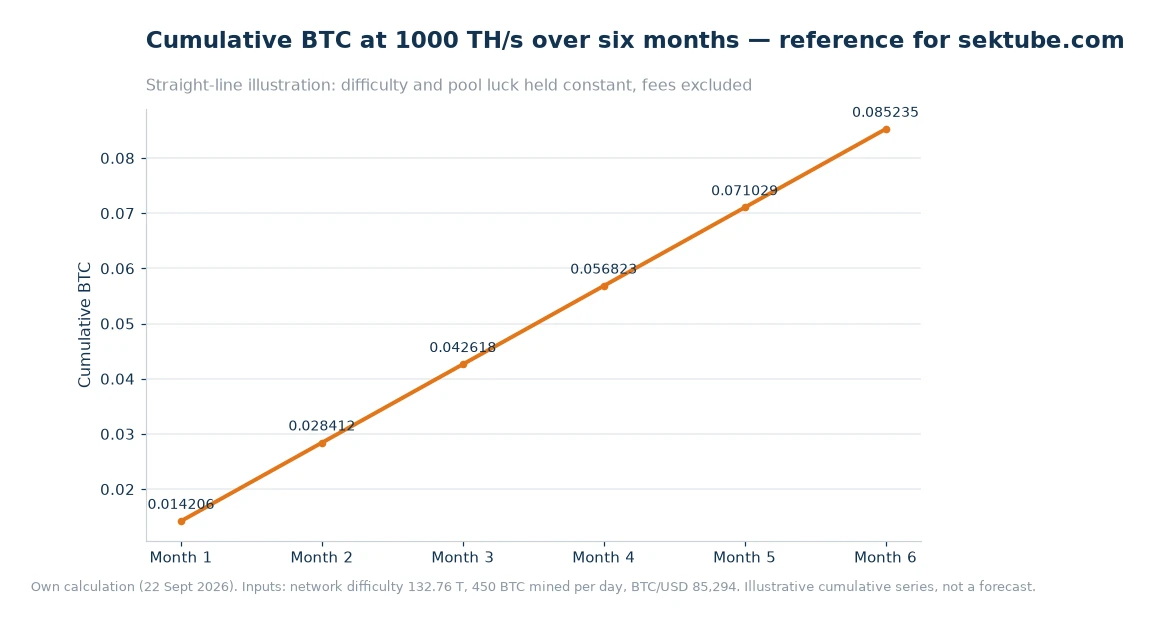
- Six months at 1,000 TH/s reaches about 0.085235 BTC, near $7,270 at a BTC price of $85,294 — the straight-line series in the chart below.
From terahashes to dollars in four steps
The conversion never changes: divide your hashrate by network hashrate to get a share, multiply that share by daily network issuance to get coins, multiply by price to get money, then apply the listed fee to the component it names. Nothing in the chain depends on which pool you use, which is why two pools offering the same payment method produce the same expected payout for the same hashrate.
Where pools do differ is in how the share is measured and when it is settled. Under PPS+ the accounting is hourly at current difficulty, so your share is read from the work that has already been accepted. Under PPLNS the share is measured across the last 5 difficulty rounds after a block has collected 6 confirmations, which means the window that decides your payment is a historical one. A difficulty round is 2,016 blocks, so at 144 blocks a day five rounds span about 70 days.
Pool Luck fits into the same picture as a correction to the numerator rather than the denominator. When the pool finds more blocks than the window expected, PPLNS payments speed up and grow; when it finds fewer, they slow down. Under PPS+ the miner is paid per share at current difficulty and does not carry that variance, which is exactly what the higher listed rate of 4% on the block-reward component covers.
| Step | Number | What it means for the payout |
|---|---|---|
| Share of network hashrate | 0.00010523% | The only figure that decides how much of issuance is yours |
| Daily block-reward income | 0.00047353 BTC, $40.39 | Gross, before any fee is applied |
| After the listed 4% fee | $38.77 a day | The fee applies to the PPS-settled block reward, not to the whole balance |
| Monthly at 30 days | 0.014206 BTC, $1,211.68 | Accrual under hourly settlement |
| Six months | 0.085235 BTC, near $7,270 | With difficulty and luck held constant, so it is arithmetic and not a forecast |
Worked example
Step one is the share. Divide 1,000 TH/s by 950,300,000 TH/s and the result is about 1.052 × 10⁻⁶, or 0.00010523%. Step two turns that into coins: the same proportion of the 450 BTC mined across the network each day is 0.00047353 BTC. Step three converts to money at $85,294, giving $40.39 gross.
Step four applies the fee. The listed 4% is charged on the block-reward component, about $1.62 a day here, which leaves $38.77. Accumulated across hourly settlements, that is 0.00001894 BTC an hour, near $1.62. Over 30 days the account accrues about 0.014206 BTC, close to $1,211.68.
Step five is the one worth repeating. The next difficulty adjustment is estimated at +1.90%. Income per terahash moves inversely with difficulty, so the daily net falls to roughly $38.05 and the month to about $1,142 — a difference of around $21, produced by no change in hardware at all. That is the cost of standing still, and it is also the reason the six-month chart below is labelled as arithmetic rather than a projection: any real six months will have a different difficulty in every column.
What changes the payout share
Four levers move the number, and only one of them is under the miner's control. Adding hashrate raises the share directly and proportionally. Network growth lowers it, with a 1.90% difficulty increase trimming about 1.86% from per-terahash income. Payment method changes when and how the share is measured, not how much work it represents. Pool Luck changes the timing of PPLNS payments without changing the long-run average.
The practical consequence is that comparisons between two fleets on different payment methods must be made over a long enough window to include the variance. Over a single difficulty round a PPLNS fleet can look far ahead or far behind a PPS+ fleet of identical size, and the gap will close over the next rounds. Confirming the underlying numbers is a matter of reading pool statistics for network hashrate and difficulty, then running the same inputs through the Profit Calculator to see how the share maps onto a daily figure.
Share accounting also has a granularity most miners never notice. A share is a probabilistic sample of work, so a small fleet's measured share over one hour can differ from its true share by more than a percent, while the same fleet measured across a month converges on the arithmetic. That is why short-window comparisons between two accounts of similar size are unreliable, and why the sensible interval for comparing payment methods is a full difficulty round rather than a single day of payouts.
Keep the check honest by watching the denominator. If network hashrate rises faster than your own, the share is falling even when local hashrate is flat, and the account view that shows both is the ViaBTC Pool Hashrate page. Nothing there is exotic; it is simply the numerator and the denominator on one screen, which is the minimum needed to know whether last month's change was paid for.
Frequently asked questions
Does hashrate share guarantee a payout amount?
It fixes the proportion of network issuance you are entitled to, and that proportion is what produces the estimate — not a fixed sum. Because difficulty and price both move, the same share gives different dollar amounts from month to month.
Why does PPLNS pay less in some months than PPS+ of the same size?
Because the PPLNS window is historical and block-driven. A quiet stretch for the pool, or a stretch with fewer blocks within the last 5 difficulty rounds, delays and shrinks payments even when your own hashrate never changed.
What does Pool Luck have to do with my share?
It affects the numerator of the payout calculation rather than the share itself. Under PPS+ the miner is paid per share and does not carry that variance; under PPLNS the miner does, and payments move with the pool's block-finding record.
Watch the denominator as closely as the numerator
Buying more hashrate is the obvious way to increase payout share and the slowest one to pay back if the network is growing at the same time. Before each purchase, put the current share, the current difficulty and the estimates for the next adjustment in one place, then ask what network growth would have to look like for the additional hardware to be neutral. If the answer is uncomfortably close to the recent trend, wait a round. Then recheck the actual share against the pool's own figures after the adjustment lands, because an assumption that was never verified is just a guess with decimals.
Rates here follow the ViaBTC listed schedule for PPS+ and PPLNS[1]. Inputs used were BTC difficulty 132.76 T with the next adjustment estimated at +1.90%, network output of 450 BTC a day, network hashrate near 950.3 EH/s and a BTC price of $85,294, read from public chain data and market feeds on 22 Sept 2026. Each figure is arithmetic on the inputs listed, not a forecast, and not a promise of earnings. read 22 Sept 2026.