One Thousandth of a Bitcoin: How Fast Four Hashrates Get There
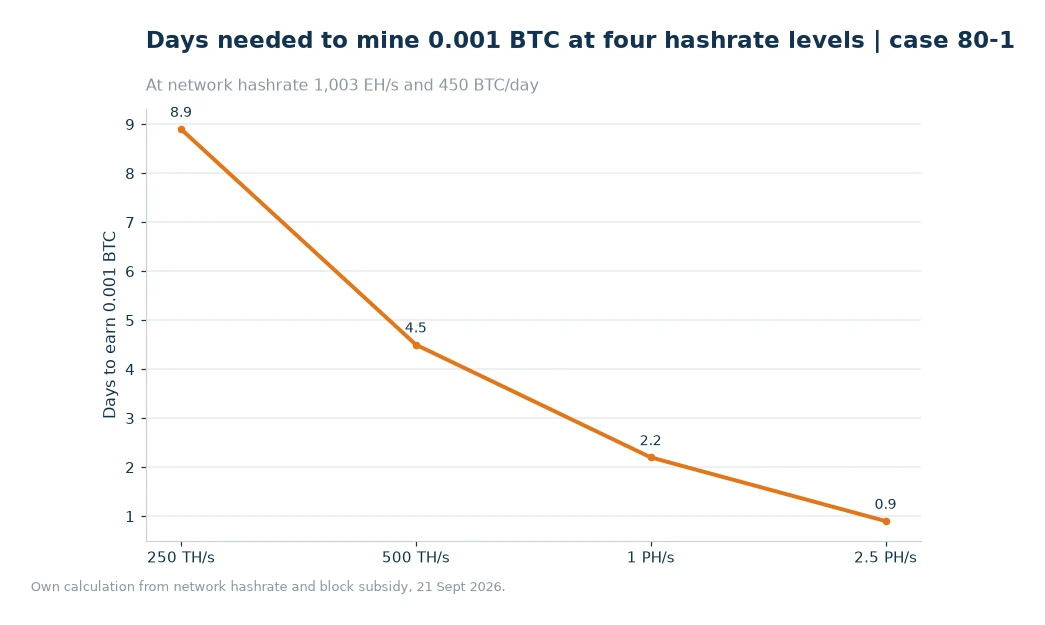
A 0.001 BTC target is small enough to use as a commissioning test. At 250 TH/s the pool credits 0.00011216 BTC a day, so the target arrives in 8.9 days; at 2.5 PH/s it lands in 0.9 days. That range covers most home and small-farm setups, which makes the target a useful ruler rather than an abstract goal.

Key takeaways
- At 250 TH/s, 0.001 BTC takes 8.9 days, or about 214 hours of running.
- Doubling to 500 TH/s cuts the wait to 4.5 days and doubling again to 1 PH/s cuts it to 2.2 days.
- The target is worth $84.69 at $84,692 per BTC, which is roughly one day of gross credit at 2.5 PH/s.
- A small target exposes downtime quickly: two missed days at 250 TH/s removes nearly a quarter of the expected total.
Why a small target works as a test
Waiting for a whole coin tells you almost nothing in a reasonable time frame. Waiting for a thousandth of a coin tells you something inside a fortnight at modest hashrate. The number is large enough that settlement noise averages out, and small enough that a mistake in the setup shows up before the machine has paid for its own shipping.
The test works better when the target is fixed in advance and the inputs are written down: rated hashrate, actual hashrate as reported by the pool, power draw at the wall, and the daily credit. Four numbers, one week apart, and the picture is clear. Miners who skip this step tend to discover a 15% shortfall months later, when the cause is harder to find.
There is a second reason to like the thousandth-of-a-coin mark: it converts into a believable electricity comparison. At 250 TH/s the gross credit is $9.50 a day at $84,692, and the run to the target takes 8.9 days, so the whole exercise grosses about $84.69. A rig drawing 3.9 kW at $0.08 per kWh spends roughly $7.49 a day, or $66.66 across the same run. The difference between those two totals is what the test is really measuring, and it is thin enough that a small error in either input shows up plainly.
The daily credit at four scales
One terahash earns 0.00000044865 BTC a day at a 1,003 EH/s network and a 450 BTC daily issuance. Everything below is that figure multiplied by hashrate, then divided into a 0.001 BTC target.
| Hashrate | Daily BTC | Days to 0.001 BTC | Hours |
|---|---|---|---|
| 250 TH/s | 0.00011216 | 8.9 | 213.6 |
| 500 TH/s | 0.00022433 | 4.5 | 108.0 |
| 1 PH/s | 0.00044865 | 2.2 | 53.5 |
| 2.5 PH/s | 0.0011216 | 0.9 | 21.4 |
The hours column is the one to keep beside a maintenance log. A rig that stops for six hours during an 8.9-day run loses about 2.8% of the expected total, which is small. A rig that stops for two full days loses 22.5%, which is not, and the loss is invisible if the only record is a monthly balance.
Worked example
Take 250 TH/s and follow the same steps a spreadsheet would.
- 450 BTC a day ÷ 1,003,000,000 TH/s = 0.00000044865 BTC per TH/s per day.
- 250 TH/s × 0.00000044865 = 0.00011216 BTC a day.
- 0.001 BTC ÷ 0.00011216 = 8.917 days, rounded to 8.9 in the chart.
- 8.917 days × 24 = 214.0 hours, which the table shows as 213.6 after rounding the daily rate.
- At 500 TH/s the daily credit doubles to 0.00022433 BTC and the wait halves to 4.46 days.
- At 1 PH/s: 1,000 TH/s × 0.00000044865 = 0.00044865 BTC a day, so 0.001 ÷ 0.00044865 = 2.23 days.
- At 2.5 PH/s the daily credit is 0.0011216 BTC, more than the target itself, so the wait is 0.89 days.
- Value check: 0.001 × 84,692 = $84.69, and at 250 TH/s the gross daily credit is $9.50.
Reading pool figures alongside your own
Your daily credit is a personal number, but it is paid out of a shared process, so two pool readings are worth understanding. The first is the total hash the pool is working with, which tells you how frequently blocks should arrive for the whole group. The second is how the pool's recent block count compares with the number difficulty implies, a ratio usually shown as a percentage.
The ViaBTC Pool Hashrate page carries both, and the pair explains most of the difference between a smooth week and a lumpy one. Pool Luck below 100% means the pool found fewer blocks than expected in that window; above 100% means more. Over months the ratio tends toward 100%, which is why a bad week is not by itself a reason to move.
Under PPS+, the default mode, that variance is largely the pool's problem rather than yours on the block-reward component, which settles hourly against current difficulty at a listed 4%. Under PPLNS the listed rate is 2% on the combined block reward and fees, and the miner carries the variance across the last five difficulty rounds after six confirmations. The choice changes the texture of the week, not the long-run arithmetic of the table above.
The first week after a rig goes live
Check the reported hashrate against the rating on the box. A 250 TH/s machine that reports 232 TH/s is running at 93%, and the 8.9-day target stretches to 9.6 days. Some of that gap is normal: pool-side hashrate is an estimate built from shares, so it moves hour to hour and settles over a day or two.
Check the reject rate next. A steady 1% to 2% is usually a network or latency matter; a spike above that often means an overheating board or a stale firmware build. Then check power at the wall, because the credit does not know what the electricity costs. A 250 TH/s rig drawing 3.9 kW at $0.08 per kWh spends $7.49 a day on power against $9.50 of gross credit, which leaves very little before fees.
Where the coin actually lands
Payouts arrive in the pool account, and the multi-currency wallet built into the same login is where they sit until moved. Zero-fee mining payouts mean the withdrawal itself does not charge a pool fee, though the chain still charges what it charges. For a small target like 0.001 BTC, that distinction matters: a withdrawal fee would have eaten a visible share of an 8.9-day run, and the absence of one makes small, frequent transfers practical.
Auto Conversion is the other useful piece at this scale. A miner paid in one coin who settles costs in another can convert inside the account rather than sending coins out and back. It is a convenience, not a strategy, and it does not change the arithmetic of the target; it just removes a step between the credit and the invoice.
Frequently asked questions
How long does 0.001 BTC take at 250 TH/s?
About 8.9 days at a 1,003 EH/s network, because 250 TH/s earns 0.00011216 BTC a day before fees and the target is one thousandth of a coin.
Is a small target a reliable way to test a new rig?
Yes, within limits. A target of 0.001 BTC is large enough to average out daily share noise and short enough to finish inside two weeks at 250 TH/s, so a shortfall shows up while the setup is still fresh.
Does pool variance change the 8.9-day figure?
Under PPS+ the block-reward component settles hourly against current difficulty, so the figure holds closely; under PPLNS the same average applies but individual weeks can land above or below it.
Write the target down before you start
Pick the target, note the date, and record the pool's reported hashrate each morning. When the balance crosses 0.001 BTC, compare the elapsed days with the table. A result inside 10% of the prediction means the rig, the network link and the account settings are all behaving, and the next target can be larger.
The ViaBTC App makes that daily note easy, since the hashrate curve and the balance sit on one screen for iOS and Android. The multi-currency wallet then shows what arrived and what is still pending, which is the pair of numbers the test actually needs.
Sources: the ViaBTC state, wallet and app pages, with chain data read 21 Sept 2026[1]. Network hashrate 1,003 EH/s, difficulty 132.76 T, 3.125 BTC per block, 144 blocks a day, BTC $84,692. Published 22 Oct 2026; day counts assume continuous uptime and a steady difficulty.