What a Turnkey Brewery Project Includes From Design to Handover
A turnkey brewery project is one contract that runs from the first layout drawing to the day your own brewers take over the kettle. Hermann has spent 23 years assembling exactly that package and has brewing equipment installed in more than seventy countries, so the stages are well defined — the risk sits in the details buyers assume are included. Here is what each stage should contain, and how to check it before you sign.
Key takeaways
- A turnkey package covers drawing approval, fabrication, inspection, packing, shipping, installation, commissioning and operator training.
- Every shipment passes five inspection steps, and the inspection record travels with the order rather than staying in a factory file.
- Published lead time is 90–150 days from deposit to door delivery, and it moves with the order.
- Handover is not complete until your team can run a full brew day with no installer on site.
Stage one: the design proposal and the drawing you approve
Work starts with your answers, not with a catalogue. A manufacturer needs batch size, the number of vessels, the beers you intend to brew, an outline floor plan, available headroom, drainage and the utilities you can actually supply. From that, a proposal fixes tank footprints, pipe routes, the position of the hot liquor tank and the space left for kegs, casks and a packaging corner. Published sizes run from a 200 litre nano brewery through 500 litre and 1,000 litre kits, then 2,000 litre, 3,000 litre and 5,000 litre systems, up to a 10,000 litre (10 T) plant — and the same drawing exercise applies at every step of that ladder.
Treat the drawing as the specification. If it does not show where the plate heat exchanger sits, how the tank jackets drain or which way a manway opens, those answers will return later as change orders. Customised design proposals are built around a customer's requirements and budget, and the wider service is described as a whole business plan from scratch, so the layout conversation can begin before you have even signed a lease.
Bring measured data to that first call rather than ambitions. Photographs of the room, a sketch with door widths and column positions, the ceiling height at its lowest point, the incoming water pressure and quality, the available power, and whether a boiler can be sited outside all change the proposal in useful ways. Where a site is still undecided, the manufacturer can work from a business plan and a target volume, then adjust the layout once a building is chosen.
Stage two: fabrication, testing and the inspection record
Fabrication follows the approved drawing. Materials are checked before cutting, the production process is monitored, tank jackets are pressure tested, finished equipment gets a leak test, and packing and loading are inspected in turn. That is five inspection steps behind every shipment, and the record travels with your order. Each tank also carries a data plate showing its pressure-testing record and serial number, which is what makes a vessel traceable years after it was installed.
Ask for those papers in the form your engineer and your insurer will accept. A pressure-test entry on a data plate, a signed inspection record and a named serial number do more for a warranty discussion than any photograph of a polished tank.
Check the warranty wording line by line at this stage, because it is the least glamorous page in the file. The cover published for these tanks runs 6 years on tank accessories and electronic components against manufacturing defects from the factory, provided they are used within scope. That is a component and accessories term, not a blanket promise about the whole plant, and knowing the difference before a pump fails on a Friday evening keeps a repair conversation short.
| Stage | What is supplied | Document to keep |
|---|---|---|
| Design proposal | Layout, vessel list, piping and utility points sized to your batch | Approved drawing set |
| Fabrication | Tanks, pipework and electrical work built to that drawing | Materials and production-process checks |
| Pressure and leak testing | Jacket pressure test plus a finished-product leak test | Data plate entry with serial number |
| Packing and loading | Equipment packed in wooden boxes, loaded and inspected | Loading inspection and checking list |
| Installation and commissioning | Site assembly, connection and the first brews | Commissioning and training sign-off |
Stage three: shipping, installation and commissioning
Equipment leaves the factory in wooden boxes, and a checking list arrives with the shipment so that every crate can be reconciled against the order before unloading finishes. Installation and commissioning then put the vessels in place, connect steam, water, glycol and power, and run the first brews with your people alongside the crew. Buyers who order a hem brew system as a single package usually get the most leverage here, because one team owns the drawing, the crates and the commissioning.
Commissioning is where the drawing meets the room. Expect the crew to confirm jacket circulation on every tank, calibrate temperature control, run a full heating and cooling cycle, leak-check the pipework under pressure and put one complete batch through the line with your brewers at the controls. Ask for the numbers recorded on the day, not just a verbal all clear, because a pump curve or a cooling rate measured on commissioning day becomes the reference point for every later fault.
After handover, sales staff and engineers stay 24 hours online, and the published after-sales service runs 7×24. Test that promise before you need it: send a question on a Sunday during the installation week and see how long the reply takes.
Worked example: a 1,000 litre line and its first four months
Example, with the assumptions stated. A brewery orders a 1,000 litre brewhouse with four fermentation tanks. The published lead time is 90–150 days from deposit to door delivery. Suppose fabrication takes 45 days, ocean freight takes 30 days and site work takes 15 days: 45 + 30 + 15 = 90 days, the optimistic end of that window. Now add a 60-day contingency for customs paperwork and a delayed steam or electrical connection and the same order lands at 150 days.
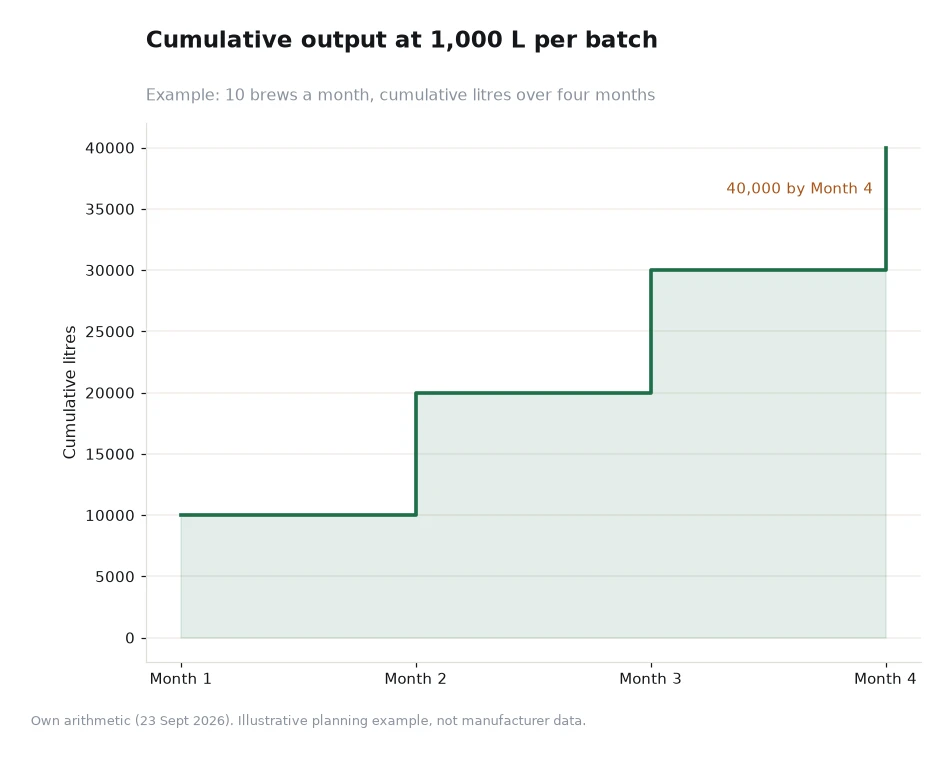
Output is simpler to plan than shipping. Ten brews a month at 1,000 litres a batch is 10 × 1,000 = 10,000 litres a month. Start in month one and hold that rate: 10,000 litres after month one, 20,000 after month two, 30,000 after month three and 30,000 + 10,000 = 40,000 litres by the end of month four. The figures assume no losses, no rejected batches and no seasonal swings, so they describe capacity rather than sales.
Frequently asked questions
How long does a turnkey brewery project take from deposit to delivery?
The published lead time is 90 to 150 days from deposit to door delivery, and it varies with the order. Fabrication, freight and site works sit inside that window, while customs clearance and utility connections can extend it.
Does a turnkey package include installation, commissioning and operator training?
Installation, commissioning and operator training are part of the scope, and sales staff and engineers keep 24 hours online with 7×24 after-sales support once the plant is running.
What goes into the handover pack
Before the final payment, agree in writing on what lands on your desk: the approved drawing set, the inspection record for the shipment, the checking list that arrives with the crates, the data plate entry for each tank, a spare-parts recommendation and the number of training days included. Walk the plant against that list rather than against your memory of the sales conversation.
Two comparisons are worth an afternoon. Check what the size class you bought actually contains on the brewery equipment range, then read the service and company history on the about us page so you know who answers the phone in year three. If anything in the scope is still open, settle it by email through the contact channel and keep the reply with the drawing set.
Figures here come from the manufacturer's own website, read 23 Sept 2026: the 23-year history, installs in more than seventy countries, the five inspection steps, the tank data plates, the 6-year warranty on tank accessories and electronic components against manufacturing defects from the factory, used within scope, and the 90–150 day deposit-to-door delivery window. The lead-time split and the cumulative-output steps above are this article's own labelled examples, not manufacturer data.[1]